Table of Contents
- Why the Bathroom Deserves Your First Attention
- Bathroom Safety Checklist for Seniors
- Installing Grab Bars in the Bathroom
- How to Make Your Bathroom Safer for Seniors: Shower and Tub Solutions
- Toilet Safety: Risers, Raised Seats and Clearance Space
- What an Occupational Therapist Bathroom Assessment Can Reveal
- Smart Home Technology and Financial Help for Bathroom Modifications
- Making Your Bathroom Safer for Seniors: Next Steps
Last Updated: August 25, 2026
The bathroom can be a particularly challenging area of the home for older adults because wet surfaces, confined spaces, and bathing activities can increase the risk of slips and falls. Many of the most effective changes take an afternoon to complete and cost far less than a hospital visit.
The core principle is straightforward: reducing the conditions that lead to slips, awkward movements, and delayed help after a fall.
Why the Bathroom Deserves Your First Attention
Bathrooms present several everyday challenges for older adults that are worth addressing early. The combination of wet surfaces, confined spaces, and the physical demands of bathing creates a uniquely challenging environment. Transitions between sitting and standing, stepping over a tub ledge, and reaching for a towel all require balance, grip strength, and coordination that can shift gradually over time.
The good news is that the bathroom responds exceptionally well to targeted modifications. Grab bars, non-slip mats, a shower bench, and a raised toilet seat are practical tools that support independence rather than signal decline. According to the Public Health Agency of Canada’s guidance on falls prevention, falls are the leading cause of injury-related hospitalizations among older Canadians, and the bathroom is a consistently identified high-risk location.
Bathroom Safety Checklist for Seniors
A bathroom safety checklist for seniors identifies what needs attention before purchasing anything. Work through each category below and note what is already in place and what is missing.
Flooring and Traction
Wet tile and smooth porcelain can contribute to bathroom slips.
- Non-slip mat or rubber-backed rug outside the shower or tub
- Suction-cup bath mat or slip-resistant decals inside the tub or shower floor
- Threshold between bathroom and hallway is flush or has a bevelled reducer strip
- No loose rugs or curling mat edges anywhere in the bathroom
- Floor is dry and well-ventilated after bathing
Slip-resistant decals add traction to tiled shower floors without requiring structural change and are easy to replace when worn.
Lighting and Visibility
Poor bathroom lighting is a tripping hazard that is easy to overlook because people adapt to it gradually.
- Overhead light is bright enough to eliminate shadows near the toilet and shower
- A night light or motion-activated light is installed for nighttime bathroom visits
- Light switch is accessible immediately upon entering the bathroom
- No burned-out bulbs or flickering fixtures
Motion-activated night lights are particularly valuable. Many bathroom-related incidents happen during nighttime visits when someone is moving quickly in low light. A plug-in motion light near the floor level illuminates the path without requiring anyone to find a switch.
Fixtures and Controls
Lever-style faucets are significantly easier to operate for anyone with reduced grip strength or arthritis.
- Faucets are lever-style rather than knob-style
- Hot water temperature is set to prevent scalding
- Handheld showerhead is installed for flexible bathing positions
- Towel bars are not being used as grab bars (they are not rated for body weight)
Water temperature control matters more than many guides acknowledge. A scald injury is a serious setback, and the fix is simple: most water heaters can be adjusted to a safer maximum temperature by a plumber or qualified technician.
Emergency Access and Alerts
Emergency access is the modification most people delay the longest, and the one that matters most if something goes wrong.
- Bathroom door opens outward, or is a sliding or folding door (inward-opening doors can be blocked by a fallen person)
- A personal emergency response system or wearable alert device is accessible from the bathroom
- A family member or neighbour knows a check-in routine
- Door lock can be opened from the outside in an emergency
An inward-opening bathroom door is a genuine hazard. If someone falls against it, emergency access becomes very difficult. Converting to an outward-opening door, a barn-style sliding door, or a folding door significantly improves emergency response options.
Installing Grab Bars in the Bathroom
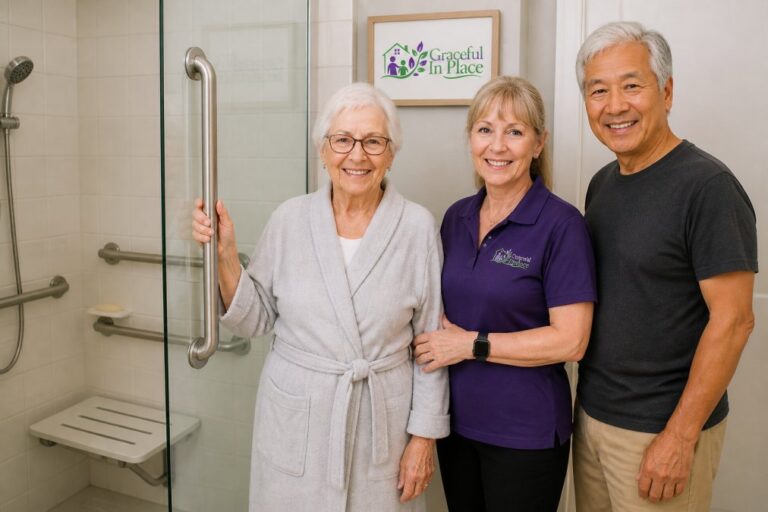
Grab bars are the single most impactful bathroom modification for most people. A properly installed grab bar provides structural support during the highest-risk moments: entering and exiting the tub or shower, lowering onto and rising from the toilet, and standing at the sink.
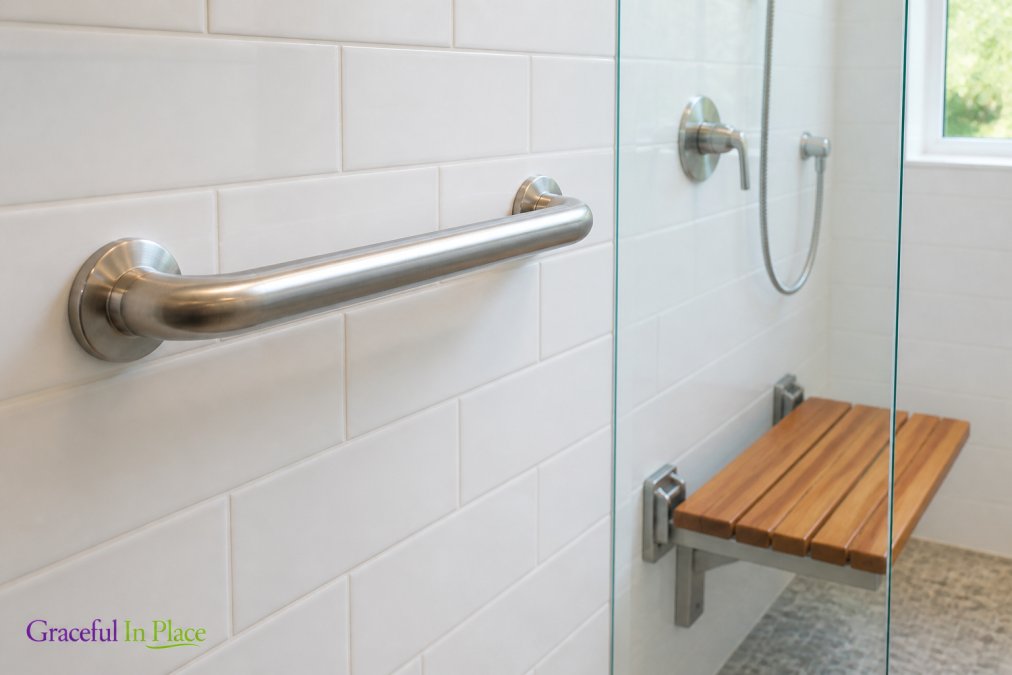
The critical word is “properly.” A grab bar that is not anchored into wall studs or blocking can pull away under load, which is worse than no bar at all. Towel bars, soap dishes, and decorative rails are not grab bars and should never be used as substitutes.
Where to Place Grab Bars
Grab bar placement follows the logic of where weight transfer and balance demands are highest.
Near the toilet:
- A horizontal bar on the side wall can support lowering and rising.
- A swing-down or fold-away bar on the open side of the toilet is useful when wall placement is limited
In the shower or tub:
- A horizontal bar on the entry wall can provide support when stepping in and out.
- A vertical bar near the entry point supports balance during the transition
Beside the sink:
- A horizontal bar on the adjacent wall supports balance for anyone who needs to steady themselves while standing
Grab bar placement is not one-size-fits-all. The right height and angle depend on the person’s height, strength, and specific mobility needs. An occupational therapist can assess and recommend exact positioning.
DIY vs. Professional Installation
DIY installation is reasonable when:
- The installer is confident locating studs accurately with a stud finder
- The wall framing is standard and accessible
- The bar comes with clear load-rated hardware and instructions
Professional installation is the better choice when:
- The walls are tiled and the installer is unfamiliar with drilling into tile
- There is uncertainty about stud location or wall structure
- The person who will use the bar has significant mobility challenges that make precise placement critical
Financial assistance for home accessibility modifications may be available through federal, provincial, territorial, municipal, or community programs, depending on eligibility and location. Check current government resources in your area before beginning a project.
How to Make Your Bathroom Safer for Seniors: Shower and Tub Solutions
Shower and tub modifications address the highest-risk transition in most bathrooms: getting in and out of the bathing area. The right solution depends on the current setup, the person’s mobility, and the available space.
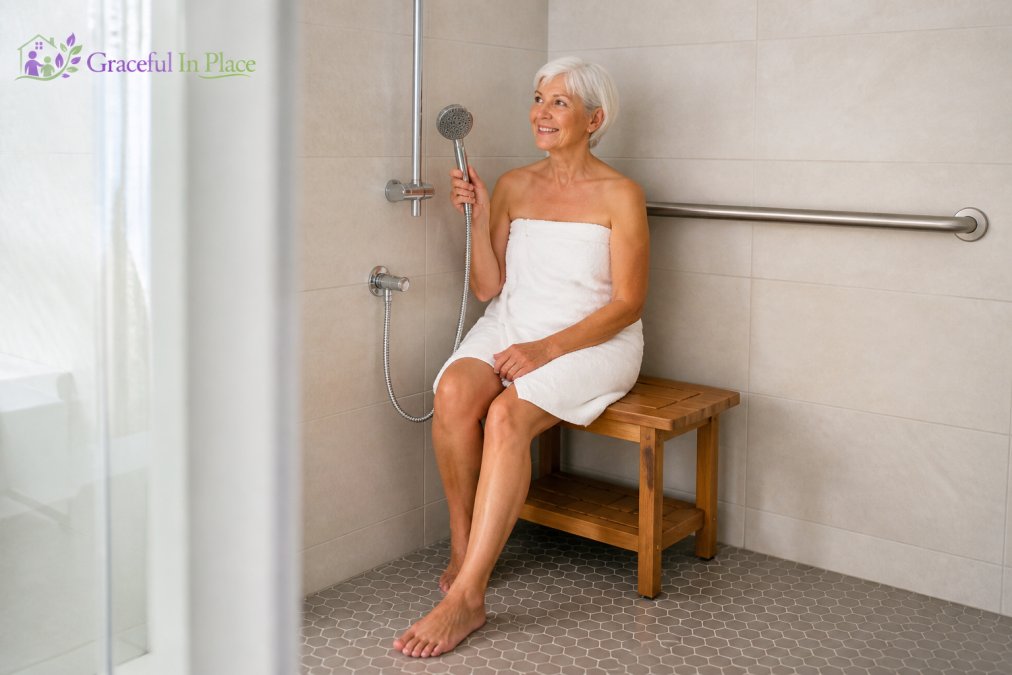
Shower Chairs, Benches and Transfer Benches
Sitting while bathing eliminates the need to stand on a wet surface for extended periods. This is one of the simplest and most effective changes available and requires no structural modification.
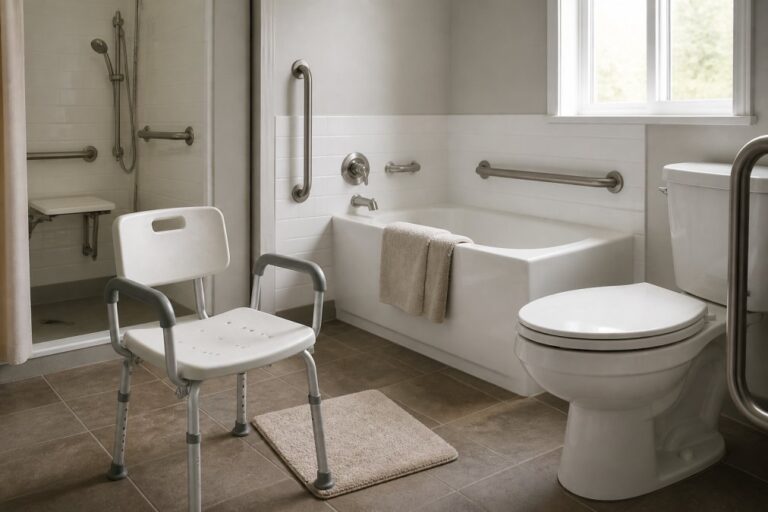
Shower chairs are freestanding seats with legs and rubber-tipped feet. They work in most shower stalls and are easy to move and clean.
Shower benches are typically wider and provide more stable seating. A teak bench adds durability in wet environments.
Transfer benches extend outside the tub edge and allow a person to sit on the dry outer portion, then slide across into the tub. This eliminates the need to step over the tub ledge entirely, which is the most hazardous moment in a standard tub-based bathing routine.
A handheld showerhead pairs naturally with any seated bathing solution and allows water direction to be controlled from a seated position.
Walk-In Shower Conversions vs. Walk-In Tubs
For households where the current bathing setup consistently feels unsafe, a structural change may be worth considering.
Walk-in shower conversions remove the tub entirely and replace it with a barrier-free or low-threshold shower. Accessible-design guidance commonly calls for a level or very low threshold; for example, Ontario barrier-free design guidance specifies a level threshold or a bevelled threshold no more than 13 mm high. This is the most accessible bathing solution for most people with mobility challenges.
Walk-in tubs have a door in the side wall that allows entry without stepping over a ledge. They appeal to people who value soaking. The practical limitation is that the person must enter, close the door, and then fill the tub, meaning they sit in an empty tub while it fills and must wait for it to drain before exiting.
Toilet Safety: Risers, Raised Seats and Clearance Space
The toilet presents a specific challenge: lowering onto a standard seat and rising from it requires significant leg strength and balance.
Raised toilet seats attach to the existing toilet and increase the seat height by 5-10 cm, reducing the distance the body must travel and the strength required. They are available with or without arms, and the arms provide additional push-up support.
Toilet seat risers with locking mechanisms are more secure than basic raised seats and less likely to shift during use.
Toilet safety frames are freestanding structures that fit around the toilet and provide grab handles on both sides. They are useful in bathrooms where wall-mounted grab bars are not feasible.
Clearance space matters as much as the toilet hardware itself. Adequate clear space beside the toilet can be important for someone who transfers from a wheelchair or uses a mobility aid. The amount of space needed depends on the person, equipment, and bathroom layout. If furniture, cabinetry, or a vanity limits this clearance, repositioning or removing the obstacle is worth addressing before adding a raised seat.
What an Occupational Therapist Bathroom Assessment Can Reveal
An occupational therapist bathroom assessment is the most reliable way to identify which modifications will actually help a specific person in their specific bathroom. This is not a generic checklist; it is an individualized evaluation.
During an assessment, an occupational therapist observes how the person currently moves through bathing and toileting routines, identifies where difficulty or risk occurs, and recommends modifications matched to that person’s strength, balance, reach, and cognitive status. A common finding is that a person has already compensated for one risk area by creating a new one elsewhere, such as gripping a towel bar for support in a way that could fail under load.
Occupational therapists are regulated health professionals in Canada. Referrals are available through family physicians, community health centres, and some provincial home care programs. Private assessments are also available and are sometimes covered by extended health benefits.
Smart Home Technology and Financial Help for Bathroom Modifications
Both smart technology and financial assistance programs are practical parts of making a bathroom safer for seniors, and both are more accessible than many people assume.
Smart Home Safety Technology
Smart home technology adds a layer of monitoring and response that physical modifications alone cannot provide. The most relevant options for bathroom safety include:
Personal emergency response systems (PERS): Wearable devices that allow a person to call for help with a button press. Modern versions are waterproof and designed for bathroom use. Some include fall detection that triggers an alert automatically.
Smart water sensors: Devices that detect water on the floor and send an alert to a smartphone. Useful for identifying leaks or overflow before they create a slip hazard.
Voice-activated assistants: Placed near the bathroom entrance, a voice-activated device allows someone to call for help, turn on lights, or contact a family member without needing to reach a phone.
Motion-activated lighting: Smart bulbs or plug-in sensors that activate lighting automatically during nighttime bathroom visits, removing the need to locate a light switch in the dark.
These technologies extend the safety net. A grab bar can help reduce fall risk, while a wearable alert system can provide a way to call for help if a fall occurs.
Financial Assistance and Tax Credits
Bathroom modifications are an investment, and cost is a real consideration for many households on fixed incomes. Several programs exist to help offset the expense.
The Home Accessibility Tax Credit (HATC): The federal government offers a non-refundable tax credit for eligible home renovation expenses that improve accessibility for qualifying individuals. Grab bar installation, walk-in shower conversions, and other structural modifications may qualify. The Canada Revenue Agency’s Home Accessibility Tax Credit information provides current eligibility criteria and the list of qualifying expenses.
Provincial home modification programs: Several provinces offer grants or low-interest loans for accessibility modifications for older adults and people with disabilities. Programs vary significantly by province; a local community health centre, seniors’ services organization, or municipal housing office can identify what is available in a specific area.
Extended health benefits: Some employer or retiree benefit plans cover occupational therapy assessments and may contribute to modification costs. It is worth reviewing the policy or contacting the benefits provider directly.
Making Your Bathroom Safer for Seniors: Next Steps
Start with the bathroom safety checklist above. Work through flooring, lighting, fixtures, and emergency access before moving to structural modifications. Many of the highest-impact changes, including non-slip mats, motion-activated lighting, lever faucets, and a raised toilet seat, require no professional installation and can be addressed immediately.
For grab bars, take the time to locate studs correctly or hire someone who will. For shower and tub modifications, consider an occupational therapist assessment before committing to a conversion. The assessment can help you avoid rework and identify the modifications that will actually make a difference for your specific situation.
| Modification | DIY Feasible? | Professional Recommended? | Priority Level |
|---|---|---|---|
| Non-slip mats and decals | Yes | No | Immediate |
| Motion-activated night light | Yes | No | Immediate |
| Lever-style faucets | Yes (basic plumbing) | For complex setups | High |
| Raised toilet seat | Yes | No | High |
| Grab bars (stud-mounted) | Yes (confident DIYers) | Recommended | High |
| Handheld showerhead | Yes | No | High |
| Shower bench or chair | Yes | No | High |
| Walk-in shower conversion | No | Yes | Medium-term |
| Door modification for emergency access | Sometimes | Recommended | Medium-term |
The Graceful In Place Trusted Advice library covers each of these topics in more depth. The goal is always the same: practical information that helps people make confident decisions for their own homes and circumstances.
Frequently Asked Questions
What are the most effective bathroom modifications for seniors?
The modifications that make the biggest practical difference are grab bars at the toilet, tub and shower; a shower chair or bench; a raised toilet seat or toilet riser; non-slip mats and slip-resistant decals on wet surfaces; and improved lighting including a nightlight for nighttime visits. These changes address the most common causes of bathroom falls and can often be introduced gradually, starting with the areas that feel least comfortable right now.
How can an occupational therapist help with bathroom safety?
An occupational therapist (OT) assesses how a person moves through their specific bathroom, taking into account balance, grip strength, mobility issues and daily routines. Rather than offering generic advice, an OT identifies the exact spots where difficulty or risk exists and recommends targeted modifications. Many OTs work through provincial home care programs or can be accessed privately. Their recommendations carry weight with contractors and can also support applications for home modification funding programs.
What should I look for when choosing grab bars for the bathroom?
Look for a grab bar designed and rated for load-bearing support, with a gripping surface appropriate for wet bathroom use and corrosion-resistant construction. Secure mounting is essential, so follow the manufacturer’s installation requirements. The appropriate size and placement depend on the intended use and the needs of the person using the bathroom. Stainless steel and chrome are durable and easy to clean. The most important factor is secure mounting into wall studs or with proper blocking behind the wall — a bar that pulls free under load offers no protection at all, which is why professional installation is often worth the investment.
Is a walk-in shower better than a bathtub for older adults?
For most older adults, a walk-in shower with a low or zero-threshold entry is easier and safer to use than a standard bathtub, which requires stepping over a high edge and lowering down into a confined space. A roll-in or curbless shower also accommodates a shower chair or bench and allows a caregiver to assist more easily. That said, if bathing is important for comfort or therapeutic reasons, a walk-in tub with a door is another option — though it requires waiting for the tub to drain before exiting, which some people find inconvenient.