
Table of Contents
- Why a Balanced Daily Routine Matters in Your 70s
- Start the Day: Morning Movement and a Simple Daily Exercise Routine for Seniors at Home
- How to Stay Active in Your 70s Without Overdoing It
- Keep Your Mind Engaged: Mental Stimulation Activities for Seniors
- A Home Safety Checklist for Aging in Place
- Eating Well, Hydrating and Resting Through the Day
- Staying Connected and Finding Purpose at Home
- Conclusion
- Frequently Asked Questions
Last Updated: September 13, 2026
Why a Balanced Daily Routine Matters in Your 70s
A daily routine can bring structure and purpose to life at home. But that doesn’t mean every hour needs to be scheduled or that everyone in their 70s should follow the same routine.
What works well depends on your health, energy, interests and the way you like to spend your day. For one person, that might include a morning walk, gardening and lunch with a friend. For someone else, it might mean gentle movement at home, reading, a favourite hobby and a phone call with family.
The goal isn’t to pack more into your day. It’s to find a comfortable rhythm that includes movement, mental stimulation, rest, social connection and, just as importantly, things you genuinely enjoy.
Start the Day: Morning Movement and a Simple Daily Exercise Routine for Seniors at Home
Mornings can be a good time to add a little movement to your day, but there is no single routine that is right for everyone.
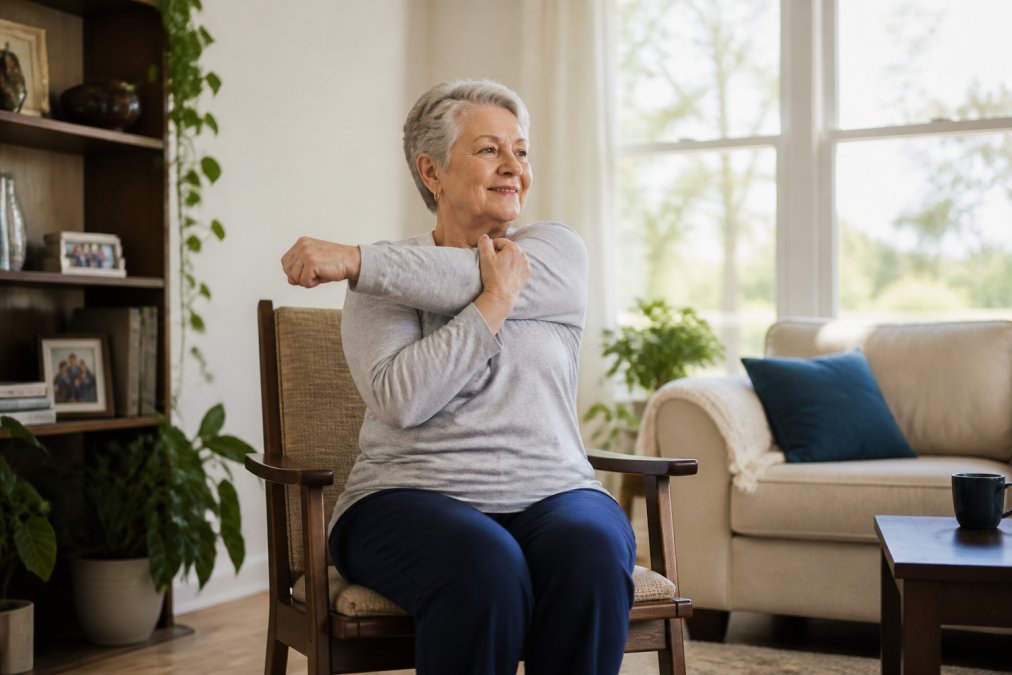
A simple daily exercise routine for seniors at home might include gentle stretching, getting up and moving around the house, taking a short walk or doing strength and balance exercises that are appropriate for you.
The important thing is to choose activities that fit your abilities and feel comfortable. You don’t need a long or strenuous workout for movement to become a regular part of your day. Even a few minutes at a time can be an easy way to build more movement into your normal routine.
Strength, Balance and Stretching: What to Include
Strength, balance and flexibility can all play a useful role in staying active as we grow older.
Strength activities help maintain the muscles we use for everyday tasks such as getting up from a chair, carrying groceries and climbing stairs. Balance activities can help us stay steady as we move around, while stretching and flexibility activities can help keep everyday movement comfortable.
What those activities look like will be different for different people. If you’re unsure what is appropriate for you, particularly if you’ve had a recent fall, surgery or a significant change in your health or mobility, a physiotherapist or another appropriate healthcare professional can help you choose activities suited to your situation.
How to Stay Active in Your 70s Without Overdoing It
Knowing how to stay active in your 70s isn’t about pushing yourself as hard as possible. A routine you’re comfortable doing regularly may be more useful than doing too much at once and then needing several days to recover.
Pay attention to how you feel during and after activity. Pain, dizziness, unusual shortness of breath or other symptoms that concern you are reasons to stop and seek appropriate medical advice rather than simply pushing through.
The goal isn’t to prove how much you can do. It’s to find a level of activity you can enjoy and maintain comfortably.
For more information about physical activity for older adults, see the Canadian Society for Exercise Physiology physical activity guidelines.
Keep Your Mind Engaged: Mental Stimulation Activities for Seniors
Keeping your mind engaged can be an enjoyable part of a daily routine. Familiar activities such as a favourite crossword can certainly have a place, but trying something new can add variety and give you a different kind of mental challenge.
Mental stimulation activities for seniors don’t need to feel like homework. The best choices are often activities you enjoy enough to keep doing, with enough variety to keep them interesting.
What Actually Counts as a Challenge
Trying something that feels a little unfamiliar can be stimulating, but it doesn’t need to be difficult or frustrating. Choose activities that interest you and give yourself permission to learn at your own pace.
Options that fit easily into a day at home:
- A daily crossword, Sudoku or word puzzle, vary the type rather than repeating the same one
- Reading a chapter of a book, or listening to an audiobook while doing something with your hands
- Learning something genuinely new: a language app, a new recipe, a musical instrument, a card game with unfamiliar rules
- Card games or board games with a family member, which add memory, strategy and social pressure
- Writing a short journal entry, a letter or a family story
- A jigsaw puzzle or model kit that requires spatial reasoning
Variety matters more than difficulty. Rotating between two or three activities keeps the brain working across memory, language, problem-solving and spatial reasoning rather than drilling one.
Using Technology Safely for Connection and Brain Training
Technology is not a replacement for in-person contact, but it is one of the most effective tools for maintaining it when distance, weather or mobility gets in the way.
A few practical starting points:
- Video calls. A tablet or smartphone set up on a stand at eye level makes video calls far easier than holding a device. A larger screen and larger text settings reduce strain.
- Brain-training apps and online puzzles. These can be a convenient way to vary mental challenge. Treat them as one option among several rather than a guaranteed way to prevent cognitive decline, the evidence for any single app is limited.
- Audiobooks and podcasts. Useful for people with low vision or tired eyes, and easy to combine with walking, cooking or gardening.
- Online interest groups. Book clubs, genealogy forums, photography groups and language exchanges all have active communities that welcome older members.
Safety matters as much as access:
- Never share banking details, passwords or personal information in response to an unexpected call, email or message
- Be cautious of anyone who contacts you first and asks for money, gift cards or cryptocurrency
- Use a strong, unique password for email and banking, and turn on two-factor authentication where it is offered
- If a message creates urgency or fear, treat that as a warning sign and verify through a number you look up yourself
The Canadian Anti-Fraud Centre publishes information about current scams and fraud. If something feels suspicious, take your time and verify it independently before responding. If a family member helps set up a device, ask them to walk through the privacy and security settings with you so you understand how they work.
Purpose Is Part of the Picture
Mental engagement and emotional well-being are closely linked. A daily routine that includes something you are responsible for, a plant, a pet, a garden bed, a weekly call to a grandchild, a small volunteer role, gives the day a shape puzzles alone cannot.
Some people find it helpful to think in terms of a reason to get up rather than a list of tasks. That reason does not have to be grand. Cooking for someone else, keeping a bird feeder stocked, mentoring a neighbour’s child or writing down family history all count. The point is that the activity matters to someone, including you.
For related reading, see our articles in Home Comfort and Bedroom Comfort.
A Home Safety Checklist for Aging in Place
Home safety is easier to think about when you look at the moments and routines that are part of everyday life. Getting up from the toilet, stepping in or out of the tub, walking to the bathroom at night or reaching for something while off balance can all be worth noticing.
A useful home safety checklist for aging in place should not simply list every possible hazard. It should help you notice where everyday tasks are becoming harder, less comfortable or less steady, and then consider what might make them easier.
It can be helpful to look around your home from time to time, especially if your health, mobility or daily routines have changed. Pay attention to the way you actually use each space, including what you carry, the routes you use most often and anything you find yourself doing differently to make a task easier.
| Area | What to Notice | What to Consider |
|---|---|---|
| Bathroom | Does the tub or shower floor feel slippery when wet? | Better traction, a safer bathing routine or added support if needed |
| Bathroom | Is sitting down or getting up from the toilet becoming difficult? | What is making the movement difficult and what kind of support might help |
| Bathroom | Is stepping through the doorway or over a threshold difficult? | Whether a simple change or professional advice could make access easier |
| Bedroom | Is the route from the bed to the bathroom clear and well lit at night? | Clear pathways and lighting that makes the route easy to see |
| Bedroom | Is getting into or out of bed becoming difficult? | What part of the movement is difficult before considering a solution |
| Hallways | Do rugs, cords, furniture or other objects make walking through the space harder? | Whether anything can be moved, secured or rearranged to create a clearer route |
| Stairs | Do you feel steady going both up and down the stairs? | Lighting, hand support and anything you routinely carry on the stairs |
| Kitchen | Do you regularly stretch, bend or reach awkwardly for things you use often? | Moving frequently used items to places that are easier for you to reach |
| Entry | Is getting through the entrance comfortable in different weather and lighting conditions? | Visibility, footing, lighting and any step or threshold that has become difficult |
Bathroom, Bedroom and Hallway Checks in More Detail
In the bathroom, pay particular attention to wet surfaces and the movements involved in bathing and using the toilet. Where does the water go, and where do your feet go? Notice whether you feel steady stepping in and out of the tub or shower and when sitting down or standing up.
If additional support would help, remember that a towel bar is not automatically a grab bar. Grab bars intended to support body weight need to be appropriate for that purpose and properly installed. If you’re unsure what type of support or installation is right for your bathroom, an occupational therapist or qualified professional can help you assess the space.
In the bedroom, think about what happens when you’re tired or half asleep. Is the route from your bed to the bathroom clear and easy to see? Is getting into or out of bed comfortable? If something has become difficult, start by noticing exactly what part of the movement is causing the problem before deciding whether rearranging the room, changing a routine, considering a product or getting professional advice would help.
In hallways and living areas, look at the routes you actually use. Rugs, cords, furniture, pet bowls and other everyday objects aren’t automatically problems, but they are worth noticing if you regularly have to step around, squeeze past or avoid them. Sometimes simply rearranging something can make the route easier to use.
Sequence Changes by Risk, Not by Cost
You don’t need to change everything at once. Start with what you have noticed in your own home and daily routine.
Something that affects you several times a day may deserve attention sooner than something you rarely encounter. A change may also move higher on the list if you feel unsteady, have had a near fall, are avoiding an activity or have developed a workaround because something has become difficult.
Ask yourself: If I changed only one thing, which change would make the biggest difference to my safety, independence or everyday comfort?
Larger changes, such as altering a shower, changing a doorway or considering equipment for the stairs, may benefit from professional advice. An occupational therapist can assess the person together with the home and help identify changes that fit individual needs and routines. The Canada Mortgage and Housing Corporation guidance on accessible and adaptable housing is also a useful Canadian resource when you’re considering larger home changes.
Think about the route you normally take from your bed to the bathroom at night. Assess it using the lighting you would normally have on. Can you see the path clearly? Is there anything you have to step around, reach over or squeeze past? Those small difficulties are worth noticing before they become bigger ones.
For more on this topic, see our guides in Home Accessibility and Bathroom Safety.
Eating Well, Hydrating and Resting Through the Day
Eating well, staying hydrated and getting enough rest are all part of supporting your energy for everyday life. But there isn’t one meal schedule, eating pattern or rest routine that is right for everyone.
Aim for meals you enjoy that include a variety of nutritious foods, and keep fluids within easy reach during the day. If preparing meals has become tiring or difficult, notice what part of the task is causing the problem. It might be standing for a long time, lifting cookware, reaching for ingredients or simply having less energy by the end of the day. Small changes in how the kitchen is arranged or how meals are prepared may make things easier.
Rest belongs in the day too. Some people enjoy an afternoon rest, while others sleep better at night without one. Pay attention to what leaves you feeling rested and comfortable. A regular evening routine can also help signal that the day is winding down.
If you have been given specific advice about food, fluids or sleep because of a medical condition or medication, follow the guidance of your healthcare professional.
Staying Connected and Finding Purpose at Home
Staying connected with other people can be an important part of enjoying life at home. How much social contact feels right will vary from person to person, but regular opportunities for conversation, companionship and community can add something meaningful to the week.
Practical ways to stay connected:
- A scheduled phone or video call with family
- A weekly visit from a friend, neighbour or faith community member
- A local seniors’ centre program, library group or walking club
- Volunteering, even in a small remote capacity
- A daily hello to a neighbour while getting the mail
Purpose matters too. Tending a plant, cooking for someone else, keeping a garden, helping a neighbour, volunteering or spending time with grandchildren can all give shape and meaning to the day. What matters is finding activities and relationships that are meaningful to you.
Your routines may change over time, and your home may need to change with them. The goal isn’t to predict exactly what you’ll need five years from now. It’s to keep noticing whether your home continues to support the way you want to live.
Conclusion
There is no single right way to structure a day at 70. A good routine is one that fits your health, energy, interests and the life you want to live.
That might include movement, a favourite hobby, time with people you care about, a little rest and ordinary tasks around the house. Some days will be busier than others, and that’s perfectly fine.
What matters is paying attention to what helps you feel well, connected and confident in your everyday life. And as your routines change, keep noticing how well your home supports them. Sometimes a small adjustment can make an everyday task easier. Other times, simply recognizing what is already working well can remind you how much your home continues to support your independence.
If something in your home is beginning to feel harder to manage, our guide to affordable home accessibility solutions can help you explore practical next steps.
Frequently Asked Questions
What do 70 year olds do all day at home?
There is no typical day that fits everyone in their 70s. Some people are working, travelling or very active in their communities, while others spend more time at home. A day might include exercise, household tasks, hobbies, reading, gardening, volunteering, time with family or friends, rest or simply enjoying some quiet time. What matters is finding a routine that fits your health, energy, interests and the way you want to live.
How much daily exercise for seniors at home is enough?
The right amount of exercise depends on your health, mobility, fitness level and the activities you enjoy. Movement can be spread throughout the day and may include walking, stretching, strength or balance activities that are appropriate for you. If you’re unsure where to begin or have health or mobility concerns, a physiotherapist or other healthcare professional can help you choose activities suited to your situation.
What should be on a home safety checklist for aging in place?
A useful home safety checklist for aging in place looks at the spaces and routines that are part of your everyday life. Pay attention to lighting, walking routes, stairs, bathrooms, entrances and anything that has become harder, less comfortable or less steady. Also notice any workarounds you’ve developed to make everyday tasks easier. The goal isn’t to find something wrong with every room. It’s to recognize what is working well and where a change might make daily life easier or safer.
How can I stay active in my 70s while spending more time at home?
Staying active at home can take many forms. You might walk, garden, do household tasks, follow an exercise program that’s appropriate for you or simply build more movement into activities you already enjoy. You don’t have to make every day a workout. Look for ways to keep moving that fit comfortably into your life and that you are likely to continue. If a health condition affects what you can safely do, ask your healthcare professional for guidance.