Table of Contents
- Why Home Accessibility Solutions Matter for Independent Living
- 1. Ramps and Threshold Modifications
- 2. Bathroom Safety and Grab Bars
- 3. Doorway Widening and Clear Pathways
- 4. Lighting and Visual Contrast Upgrades
- 5. Government Grants for Home Accessibility in Canada
- 6. Occupational Therapist Home Assessment for Planning
- 7. Low-Cost DIY Modifications You Can Start Today
Last Updated: August 28, 2026
Why Home Accessibility Solutions Matter for Independent Living
The ability to move safely through your home without assistance is fundamental to maintaining independence as you age. Home accessibility solutions remove barriers that make everyday tasks difficult or risky, allowing you to navigate your living spaces with confidence. Whether you’re planning ahead or responding to changes in mobility, thoughtful modifications transform your home into a space that works with your body rather than against it.
Many effective modifications are low-cost, can be installed without permanent changes to your home, and address the specific challenges you face in daily routines. This guide covers practical solutions across the areas where older adults face the most challenges: entryways, bathrooms, hallways, stairs, and lighting. You’ll find options ranging from simple hardware swaps to more involved structural changes, along with information about government support programs that can help offset costs.
1. Ramps and Threshold Modifications
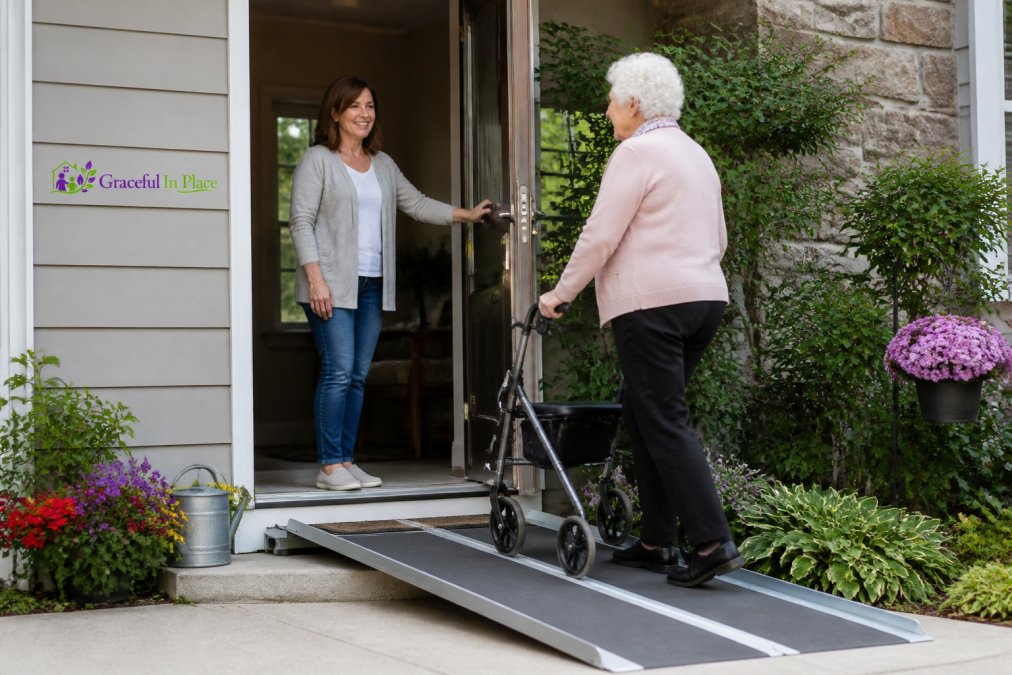
Ramps and threshold modifications address one of the most common barriers to aging in place: the step up into your home. Whether you use a wheelchair, walker, or simply find steps increasingly difficult, a ramp transforms entry from a hazard into a manageable transition.
Portable and Permanent Ramp Options
Portable ramps offer flexibility for renters or those uncertain about permanent modifications. These lightweight aluminum or rubber ramps can be positioned at doorways, decks, or porches and removed if you move. Installation takes minutes with no tools required.
Permanent ramps are built into your home’s structure, typically alongside or replacing front steps. A professional contractor should assess your entryway and calculate the appropriate slope. A professional contractor or accessibility specialist should assess your entryway and determine an appropriate ramp slope based on the site, the user’s needs, and applicable local building requirements. Longer, gentler ramps are generally easier to navigate than steep ones.
Non-slip surfaces are essential, textured aluminum, rubber, or composite materials prevent slipping when wet. Handrails on at least one side are important for balance, particularly if you’re using a mobility aid.
Threshold Ramps for Interior Doorways
Interior doorways often have small raised thresholds that catch wheels on walkers or wheelchairs or create trip hazards. Threshold ramps bridge these gaps smoothly. They’re available in rubber or aluminum and can be permanently adhered or positioned temporarily. Temporary threshold ramps work well in rental homes and are easy to remove without damage.
Measure the doorway’s clear opening and make sure your mobility aid can pass through comfortably.
2. Bathroom Safety and Grab Bars
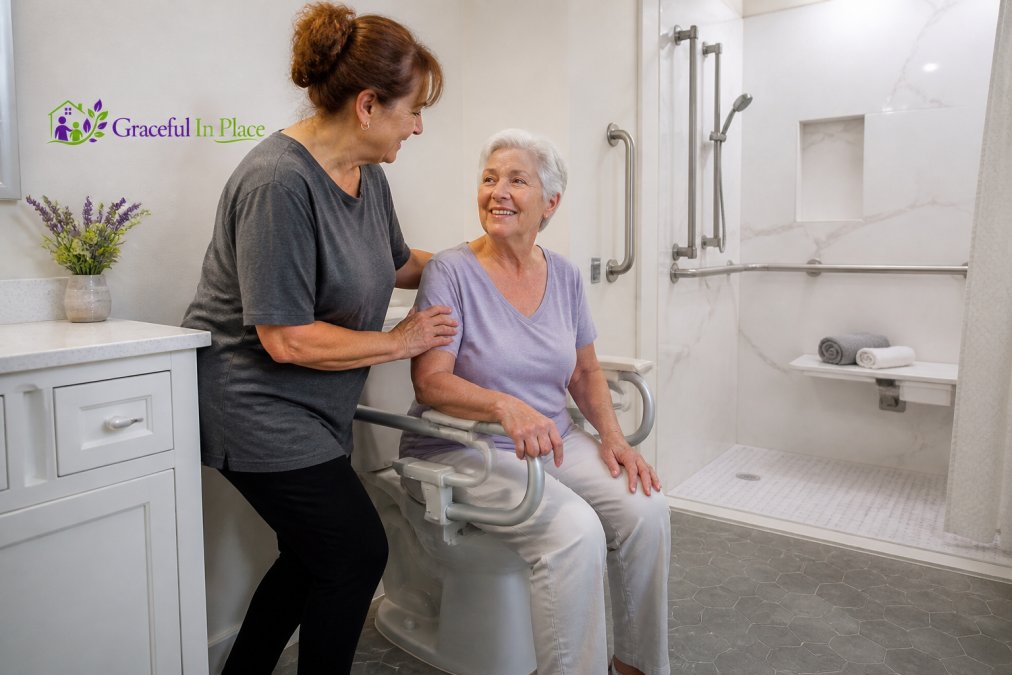
The bathroom is where many falls occur because it combines water, smooth surfaces, and the need to balance while reaching or transferring. Grab bars, non-slip flooring, and transfer aids address these specific hazards.
Choosing and Installing Grab Bars
Grab bars provide stability when moving between standing and sitting, entering or exiting a shower, or lowering yourself onto a toilet. They must be securely mounted using appropriate structural support and manufacturer-approved hardware.
Placement is critical and should reflect the user’s height, reach, mobility, and the way the bathroom is used. An occupational therapist or accessibility specialist can help determine appropriate placement for the individual and the space. Textured surfaces provide better grip than smooth finishes, especially when wet.
Placement is critical. Vertical bars beside the toilet help with the sit-to-stand transfer. Before widening a doorway, measure the clear opening and the mobility aid that will pass through it. An occupational therapist or accessibility professional can help determine whether the existing opening is actually limiting safe movement.An occupational therapist or accessibility specialist can assess your specific needs and recommend placement that matches your height and mobility pattern.
Suction-mounted or adhesive bathroom handles should not be assumed to provide the same weight-bearing support as properly installed grab bars. Always follow the manufacturer’s instructions and intended use.
Non-Slip Flooring and Transfer Benches
Wet bathroom floors are inherently slippery. Non-slip bath mats with suction cups provide temporary traction. For a more permanent solution, non-slip flooring materials, textured tile, rubber, or specialized coatings, reduce slip risk substantially. Non-slip adhesive strips applied to existing tile offer affordable protection.
Transfer benches sit across the edge of your tub, allowing you to sit on the bench outside the tub, swing your legs over, and slide into the tub while seated. This eliminates the balance challenge of stepping into a tub. Benches are adjustable in height and come with non-slip feet to prevent sliding.
Walk-in tubs or shower stalls with a low or zero-threshold entry eliminate the need to step up into a tub. These are more expensive modifications, but they remove a significant barrier for people with mobility challenges.
3. Doorway Widening and Clear Pathways
Doorways that are too narrow for wheelchairs or walkers create forced detours through your home. Before widening a doorway, measure the clear opening and the mobility aid that will pass through it. An occupational therapist or accessibility professional can help determine whether the existing opening is actually limiting safe movement.
Widening a doorway involves removing the existing door frame and installing a wider frame, a structural change that requires a contractor.
Clear pathways throughout your home reduce trip hazards and make movement easier. Remove throw rugs, electrical cords, and other obstacles from high-traffic routes. Rearrange furniture to create wider passages if needed. Make sure pathways are wide enough for the mobility aids used in the home, with enough room to turn and move comfortably.
4. Lighting and Visual Contrast Upgrades
Poor lighting increases fall risk by making steps, thresholds, and obstacles harder to see. Task lighting, bright, focused light at specific work areas, is more effective than relying on general room lighting. Under-cabinet lighting in kitchens illuminates countertops. Bedside lamps with easy-to-reach switches help you see when getting out of bed at night. Bathroom vanity lighting should avoid shadows on your face and the sink area.
Motion-activated lights in hallways and bathrooms turn on automatically when you move through the space, eliminating the need to find a light switch in the dark.
Visual contrast helps your eyes distinguish between different surfaces. Dark-colored grab bars against light walls are easier to spot. Contrasting tape on the edge of stairs makes each step more visible. Light switches that contrast with the wall color are easier to locate. These small changes compound into significantly improved visibility and safety.
5. Government Grants for Home Accessibility in Canada
Several government and tax-based programs help offset the cost of home accessibility modifications.
Federal Home Accessibility Tax Credit
Canada’s Home Accessibility Tax Credit (HATC) is a non-refundable federal tax credit for eligible home renovations that improve accessibility or reduce the risk of injury. It may be available to qualifying seniors age 65 or older, people eligible for the Disability Tax Credit, and certain eligible family members. Eligible expenses of up to $20,000 per year may qualify. Because eligibility and qualifying-expense rules apply, check the current Canada Revenue Agency guidance before undertaking work or claiming the credit.
Contact CRA or a financial advisor to confirm your eligibility.
Provincial and Municipal Programs
Provincial, territorial, and municipal accessibility programs vary by location and may change over time. Some jurisdictions offer tax credits, grants, loans, or other assistance for eligible home modifications. Check your provincial or territorial government website and your municipality for current programs and eligibility requirements.
Municipal governments sometimes offer additional support. Contact your local municipality’s social services department or seniors’ office to learn about programs in your area.
Applying for grants typically requires documentation of your disability or mobility limitation, proof of income, and quotes from contractors for proposed work.
6. Occupational Therapist Home Assessment for Planning
An occupational therapist (OT) conducts a thorough evaluation of your home and your specific mobility needs, then recommends modifications tailored to your situation. This professional assessment prevents costly mistakes by investing in modifications that address your actual barriers.
During a home assessment, an OT observes how you move through your home, identifies specific hazards, and discusses your goals for independence. They measure doorways, assess lighting, evaluate bathroom layout, and note environmental factors that affect your safety. They ask about your daily routines to understand which barriers matter most to you.
Based on this assessment, the OT provides a written report with prioritized recommendations. This prioritization helps you allocate your budget effectively.
Access to occupational therapy services and coverage varies by province, health program, and private insurance plan. Check with your healthcare provider, provincial or local health services, and insurance provider to find out what options are available in your situation.
7. Low-Cost DIY Modifications You Can Start Today
Several modifications are affordable, straightforward to install, and make meaningful differences in safety and ease of movement.
Lever-Style Handles and Hardware
Replacing doorknobs with lever-style handles makes doors easier to open if you have limited hand strength or dexterity. Lever handles require less gripping force than round knobs; you push down with your hand, forearm, or even your knee. Interior lever handles are inexpensive and install with basic tools in minutes.
Similarly, replacing cabinet knobs and drawer pulls with lever-style hardware makes kitchens and bathrooms more accessible.
Handrails and Stair Safety
If your home has stairs, handrails on at least one side, ideally both sides, provide stability and support when climbing or descending. When choosing a handrail, look for one that is easy to grasp comfortably. As a general accessibility reference, circular handrails are commonly designed at roughly 3 to 4.3 centimetres (30–43 mm) in outside diameter, although applicable requirements can vary by location and installation.
Stair tread tape, adhesive, non-slip material applied to the edge of each step, makes each step more visible and provides traction. This is particularly helpful at the top and bottom of a staircase.
Stairlifts allow people with significant mobility limitations to move between floors safely. A qualified installer assesses your staircase and ensures the lift is properly secured and operates smoothly.
Task Lighting and Emergency Response Systems
Adding task lighting in areas where you spend time, beside your bed, at your reading chair, in the kitchen, improves visibility and safety. LED bulbs are energy-efficient and long-lasting. Battery-powered under-cabinet lights or adhesive-backed strip lights are easy to install without rewiring.
Nightlights in hallways and bathrooms help you navigate safely during nighttime trips. Motion-activated nightlights turn on automatically.
Personal emergency response systems allow you to call for help if you fall or experience a medical emergency. These systems typically consist of a wearable device worn as a pendant or wristband that connects to a monitoring center. Pressing the button alerts trained responders who can contact emergency services or a family member.
Frequently Asked Questions
What are the most important home accessibility solutions to start with on a budget?
Begin with the areas you use most frequently: bathroom grab bars, improved lighting, and threshold ramps or leveling. These modifications address the highest-risk activities—bathing, moving between rooms, and entering your home—and are often the most affordable to implement. A safety audit with an occupational therapist can help you identify which modifications will make the biggest difference for your specific needs and home layout.
Are there government grants for home accessibility in Canada?
Yes. Canada’s federal Home Accessibility Tax Credit may provide tax relief for eligible accessibility renovations, and some provinces, territories, and municipalities offer additional programs. Eligibility and available assistance vary, so check current federal, provincial or territorial, and municipal government resources before planning a project.
How do I know if I need an occupational therapist home assessment?
An occupational therapist home assessment is valuable if you’re experiencing mobility challenges, recovering from an injury, or planning major modifications. They evaluate your specific needs, home layout, and daily routines to recommend solutions tailored to you—not generic advice. This assessment can also help you prioritize which modifications to fund first and may qualify for coverage through your provincial health plan or private insurance.
What’s the difference between portable and permanent ramps?
Portable ramps are removable, lightweight, and work well for temporary needs or rental homes. They’re more affordable upfront but require storage and manual placement. Permanent ramps are built into your home’s structure, offer better stability and weather protection, and don’t need to be stored. Your choice depends on your living situation, how frequently you need the ramp, and whether your home’s entrance allows permanent installation.
Can I make my home more accessible without major renovations?
Absolutely. Many affordable solutions don’t require structural changes: grab bars, lever-style door handles, task lighting, non-slip mats, and threshold ramps can all be added without renovation. Universal design principles—like wider doorways, clear pathways, and visual contrast—can guide future choices. Start with low-cost modifications that address your immediate safety concerns, then plan larger changes as your needs evolve or funding becomes available.